Logo Technica Engineering

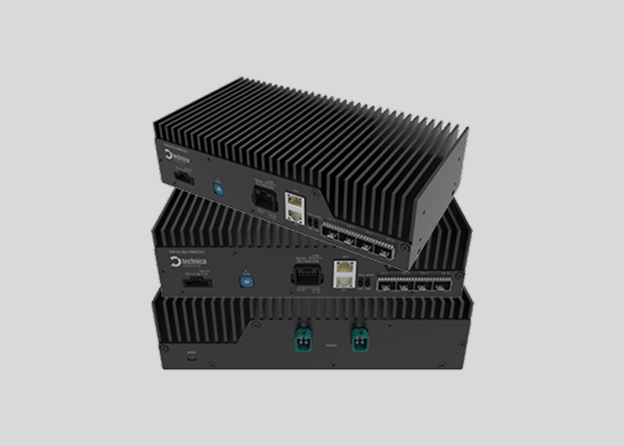
Capture Module SerDes Campaign

Unlock real time and
lossless data
validation for ADAS &
autonomous driving

Capture, compress, and validate High -Speed sensor data—without bottlenecks, complexity or compromise.

Why data validation is harder than ever?

By 2030, autonomous vehicles are projected to generate over 4 terabytes of data per day. This explosion is driven by a rapidly growing array of high

resolution cameras, LiDARs (Light Detection and Ranging), radars and ultrasonic sensors. Each sensor must transmit uncompressed latency

sensitive data to Electronic Control Units (ECUs) in real time—making the vehicle’s internal data network as

critical as its engine. Here’s what makes validation so complex?

Storage overload and increasing costs

Uncompressed sensor data quickly fills up storage, driving up costs and complicating long term data management.

Fragmented toolchains

Engineers often juggle separate devices for logging, testing and simulation — none of them talk to each other, leading to inefficiencies and data silos.

Latency and data corruption risks

Even a few milliseconds of delay or a single corrupted frame can undermine safety-critical functions like emergency braking or lane keeping.

Configuration and debugging nightmares

Proprietary protocols, complex sensor-ECU pairings and evolving standards mean every setup is unique and challenging to validate.

Sensor growth

Vehicles now feature up to 16 cameras and multiple other sensors, each demanding reliable high-speed data capture.

Data validation does not need to be hard

The SerDes Capture Module GMSL2/3 is engineered to solve the toughest validation challenges in

ADAS (Advanced Driver Assistance Systems) and autonomous driving.

It’s not just a tool — it’s a strategic enabler for engineering teams.

Here’s how it helps:

System-icon

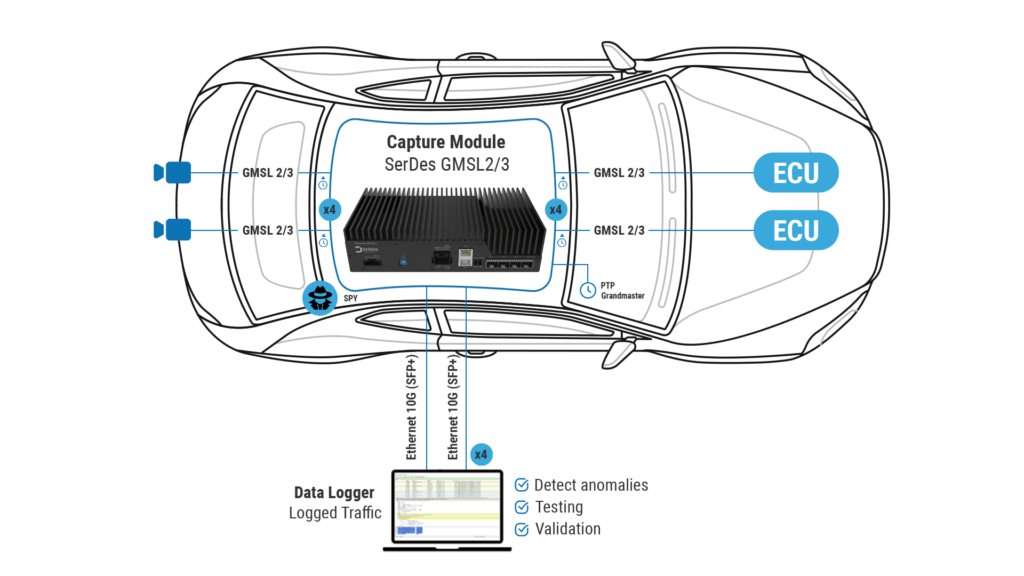
In-vehicle data logging

Capture up to 4 cameras per module at 40Gbps throughput. Lossless JPEG compression with dynamic Huffman tables lets you save up to 50% on storage — without losing a single pixel, even if scenes and lighting conditions change.

Testing-icon

Sensor testing

Validate sensors in lab or field setups. Real-time diagnostics and galvanic isolation ensure interference-free data, so you can trust every frame.

Validation-icon

ECU simulation

Inject pre-recorded sensor data into ECUs for HIL (Hardware-in the-Loop) testing. The hardware loop architecture guarantees minimal latency and zero corruption, so your simulations are as close to reality as possible.

Where SerDes makes the difference: practical use case

Join our webinar: SerDes technologies in action

Discover how SerDes technology is transforming sensor validation for ADAS and autonomous driving.

Our expert-led webinar will walk you through real-world use cases, technical insights and best practices for

leveraging the Capture Module SerDes GMSL2/3.

Why attend?

  • Learn how SerDes solves complex validation challenges
  • Explore live demos of Capture Module SerDes in action

  • Get answers from Technica Engineering experts

SerDes technologies in action: enabling smarter sensor validation

Date: November 7, 2025

Time: 4pm Munich | 8:30pm Mumbai | 10am Detroit

SerDes technologies in action: enabling smarter sensor validation

Date: November 12, 2025

Time: 10am Munich | 2:30pm Mumbai | 4am Detroit

Why is this different?

ecu

Unified Workflow: One device replaces multiple fragmented tools, streamlining your validation pipeline.

test

Seamless integration: compatible with gstreamser, a widely used multimedia frameworks, and highly configurable via an embedded web interface.

hil

Scalable and future-ready: modular design allows you to cascade multiple modules for larger sensor arrays, and has scope for evolving standards like ASA ML or MIPI-APHY.

How SerDes technology powers reliable validation?

SerDes (Serializer/Deserializer) is the backbone of high-speed asymmetric automotive data networks. It serializes sensor data intohigh-speed

serial streams, transmitting it over a single cable, and reconstructs it at the EC — all with latency under 1 microsecond and

bandwidth up to 32Gbps. Key Technical Innovations include

Lossless JPEG compression

Dynamic Huffman tables adapt in real time to changing scenes and lighting, ensuring optimal compression and data integrity.

Minimal latency hardware

Unique design to minimize the data forwarding latency from your cameras to the ECU, guaranteeing real-time response and uncompromised data integrity.

Advanced diagnostics

Embedded web interface provides configuration, monitoring and error alerts, so you’re always in control.

Modular, future-ready design

Robust anodised aluminium case, scalable for larger sensor arrays, and compatible with evolving standards. Furthermore, integrated galvanically isolated DC/DC provides decoupling between the coaxial ground and battery ground, ensuring reliable data capture in harsh automotive environments.

Non-intrusive vehicle integration

No interference of the Capture Module to the vehicle architecture, allowing its integration into dedicated recording cars without impacting the software running on the vehicle ECUs.

Easily configurability

Through a user-friendly webpage-based GUI, the required parameters to establish a SerDes link for video transmission can easily be configured. The configuration is decoupled from the device firmware allowing quick adaptability of the device to any use case.

timestamping

Lossless JPEG Compression

sync

Hardware Loop Architecture

sync

Galvanic Isolation

sync

Advanced Diagnostics

traffic

Modular, Future-Ready Design

Built for engineers, trusted by OEMs

Global automotive innovators rely on the Capture Module SerDes to streamline validation, accelerate development, and reduce costs.

A leading European OEM deployed multiple modules to log data from 8 cameras in a prototype autonomous vehicle — achieving seamless, lossless data capture and real-time synchronization.

Contact Us

Need more information?

Connect with our
sales representative now

Let’s Connect With Us

Feedback Form